
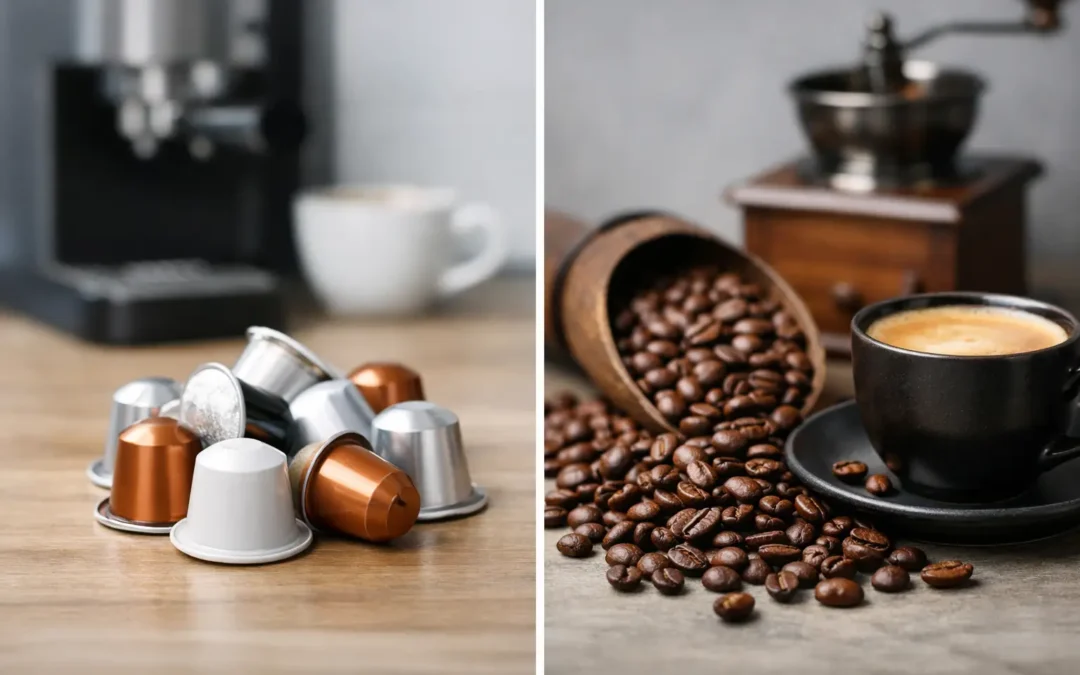
That first coffee of the day tells you a lot. If it smells flat before it even hits the cup, or tastes sharp one morning and dull the next, the format is usually the reason. When people weigh up coffee pods vs fresh beans, they are really deciding what matters most – speed, flavour, consistency, cost, or the simple pleasure of a better daily ritual.
There is no need to turn it into a purity test. Pods exist for a reason. They are quick, tidy and familiar in homes and offices where nobody wants to fuss with grinders, dosing or dialling in. Fresh beans, though, give you something pods rarely match: aroma that actually fills the room, richer flavour in the cup, and more control over how your coffee tastes.
Coffee pods vs fresh beans: what actually changes?
The biggest difference is freshness. Coffee is at its best when it has been roasted recently, stored well and ground just before brewing. That is when you get the full character of the bean – chocolate, caramel, nuts, citrus, stone fruit, spice, depending on the origin and roast profile.
Pods are pre-ground coffee sealed in a capsule. That helps preserve them better than a bag of pre-ground coffee left open in the cupboard, but it is still a compromise. Once coffee is ground, it starts losing aromatic compounds quickly. The sealed pod slows that decline, but it does not reverse it. You get convenience and a decent level of consistency, but not the same liveliness you get from grinding fresh beans right before extraction.
Texture changes too. A well-brewed espresso from fresh beans has more body, more crema and usually a cleaner finish. Pod coffee can be pleasant, but it often tastes narrower – less depth, less sweetness, less distinction between blends.
Flavour and aroma: where fresh beans pull ahead
If you care about taste, fresh beans have the clear advantage. Specialty coffee is built on freshness because flavour is not static. A bean roasted in small batches and brewed within its ideal window can taste layered and expressive. You notice the sweetness. The acidity feels bright instead of harsh. Milk drinks taste fuller because the espresso underneath has enough character to cut through.
That matters at home, and it matters even more in workplaces and events. When coffee is part of the experience, people notice quality straight away. A flat white made with freshly ground beans has a richer aroma before the first sip, and that sensory hit shapes the whole impression.
Pods tend to flatten those details. They can produce a drinkable cup, especially for someone who prioritises routine over nuance, but they rarely show the full potential of the coffee itself. Different pod varieties often end up tasting more similar than they should.
Why grinding fresh makes such a difference
Grinding exposes more surface area of the coffee to air. That is great for extraction in the moment and terrible for long-term flavour. The closer the grind is to the brew, the more of the coffee’s natural oils and aromatics stay in the cup instead of disappearing into the air or going stale in storage.
That is why a freshly brewed coffee can smell so vivid. It is not marketing fluff. It is chemistry, and you can taste it.
Convenience: where pods earn their place
Now for the fair part. Pods are convenient, and sometimes convenience is the deciding factor. In a busy office kitchen, a pod machine can seem like the perfect fix. It takes up little bench space, there is minimal training involved, and cleanup is easy. For households where coffee is more about function than ritual, that simplicity is attractive.
There is also less room for user error. With fresh beans, the result depends on the grinder, the machine, the recipe and the person making it. Pods remove most of that. Press a button and you get a predictable result.
But convenience has layers. If the pod machine breaks, locks you into a proprietary system or delivers mediocre coffee that sends your team back out for cafe runs anyway, it is not really solving the whole problem. Convenience without quality can be a short-term win and a long-term compromise.
For many businesses, there is a middle ground that works better: fresh beans with the right equipment and support, or a mobile coffee setup when the occasion calls for something more polished. That way, convenience does not come at the cost of flavour.
Cost over time: pods often look cheaper than they are
At first glance, pod machines can seem economical. The machine itself may be affordable, and the portion-controlled format feels neat and manageable. But per cup, pods are usually more expensive than brewing fresh beans.
A bag of quality beans stretches further than many people expect, especially once you calculate the number of coffees you can get from it. Pods build packaging cost into every single serve. You are paying for the capsule, the compatibility system, the branding and the convenience factor every time.
For offices, the gap gets wider. A team drinking multiple coffees a day burns through pods quickly, and the spend adds up. Fresh beans paired with an espresso machine or bean-to-cup setup can offer far better value while lifting the quality of every cup.
There is also the hidden cost of underwhelming coffee. If staff still buy takeaway because the office machine is not cutting it, you are paying twice.
Waste and sustainability: the awkward truth about pods
Waste is where pods struggle most. Single-serve coffee creates single-serve rubbish. Some brands offer recycling programs or compostable options, which is a step in the right direction, but the reality is still more packaging per cup.
Fresh beans are simpler. Buy whole beans in a bag, grind what you need, compost the spent grounds if you can, and you have already reduced the packaging load significantly. For coffee drinkers trying to make better choices without overcomplicating the routine, beans usually make more sense.
This matters for businesses too. Clients and staff notice the small signals. A premium coffee experience that also reduces unnecessary waste feels more in step with modern expectations.
Coffee pods vs fresh beans for home, office and events
The best choice depends on where the coffee is being served and what the coffee needs to do.
At home, pods suit people who want speed and very little cleanup. If coffee is mainly a caffeine stop before the school run or commute, that may be enough. But if the morning cup is something you actually look forward to, fresh beans are the upgrade you will taste every day.
In offices, pods can cover the basics, but they rarely create a coffee culture people get excited about. Fresh beans tend to lift the whole experience – better smell in the kitchen, better taste in the cup, and a stronger sense that the workplace has put some thought into quality.
For events, pods usually feel like a backup option rather than a feature. Guests remember coffee that is made fresh, served well and genuinely enjoyable. That is especially true for brand activations, corporate functions and community gatherings where every touchpoint reflects on the host.
When pods make sense
Pods make sense if bench space is tight, coffee volume is low, and nobody wants to learn even basic machine use. They can also work in holiday homes, temporary setups or as a fallback for occasional drinkers.
When fresh beans are worth it
Fresh beans are worth it when flavour matters, when people drink coffee regularly, or when the coffee says something about your standards. That applies to home enthusiasts, workplaces that want to look after staff properly, and events where quality should feel intentional.
A freshly roasted blend with the right machine does not just taste better. It feels more generous.
The real question is what kind of coffee experience you want
This is the heart of the decision. Are you after the fastest possible route to a hot drink, or do you want coffee that smells incredible, tastes distinct and feels like a small upgrade to the day?
Coffee pods deliver convenience, and for some people that will be enough. Fresh beans ask a little more, but they give much more back – better aroma, better flavour, more flexibility, and often better value over time.
For anyone who cares about cafe-quality coffee without making life harder than it needs to be, fresh beans are usually the stronger choice. That is why specialty roasters put so much emphasis on roast date, grind quality and brewing fresh. The difference is not subtle once you know what to look for.
If your current setup is easy but uninspiring, that is probably your answer. The best coffee routine is not the one with the fewest steps. It is the one that makes every cup worth stopping for.
Try it fresh. Our OmniSoul blend is roasted in small batches in Adelaide, with delivery included Australia-wide and 10% off when you subscribe. Visit the shop.