

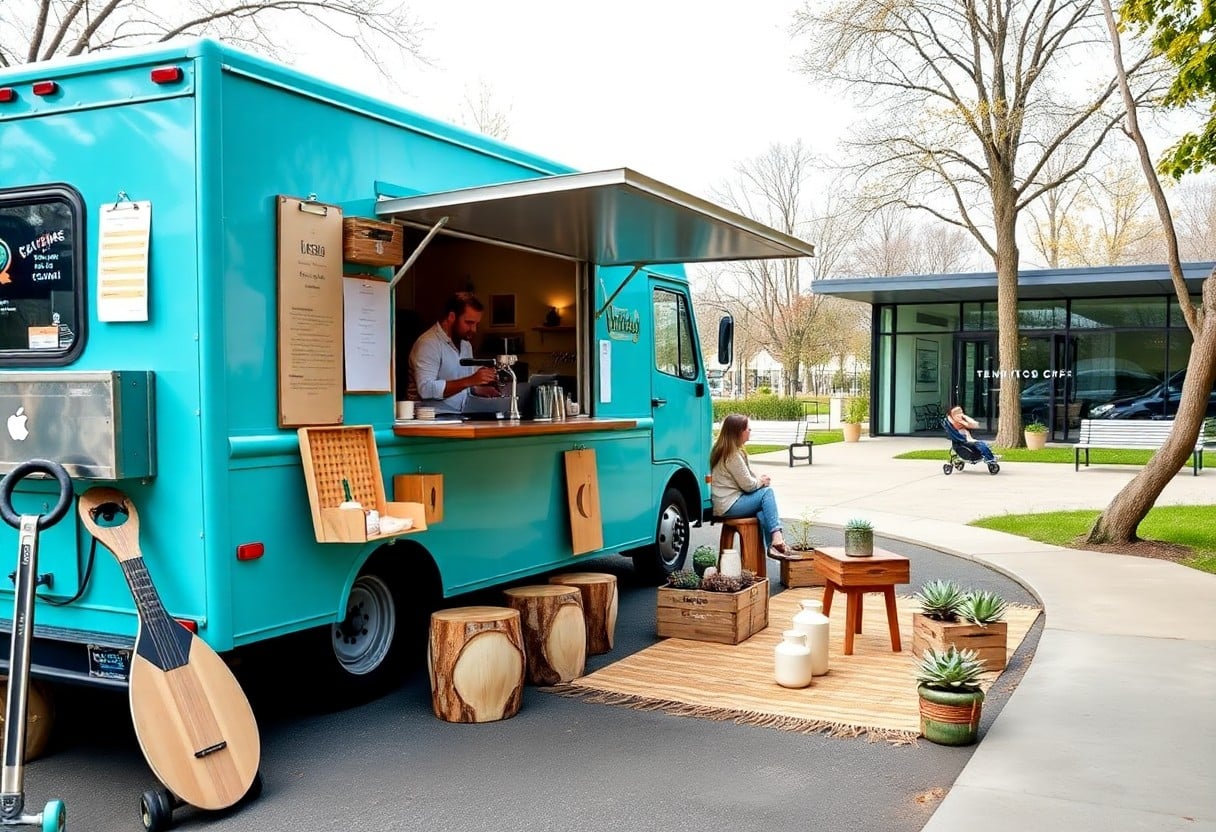
There’s evidence that you can build deeper community with ephemeral coffee vans than with a stationary café, because vans meet diverse groups, spark spontaneous rituals, and adapt locations to community rhythms.
Key Takeaways:
- Ephemeral coffee vans create localized, high-energy social moments by moving into different neighborhoods and events, attracting passersby and building brief but meaningful connections.
- Stationary cafés offer consistent routines and third-place stability, producing repeat encounters and rituals that deepen long-term relationships among regulars.
- Combining mobile pop-ups with consistent schedules, community partnerships, and digital follow-ups delivers both reach and continuity, increasing the likelihood of sustained community ties.
The Psychology of Transience: Why Temporary Spaces Foster Connection
Transient coffee vans create time-bound rituals that heighten your attention, turning brief encounters into memorable connections and making small talk feel more intentional.
You respond to temporary settings by prioritizing interaction over routine, so those quick exchanges often become the memorable social moments that outshine habitual café visits.
The scarcity principle and its impact on social urgency
Limited hours and locations signal a finite opportunity, which pushes you to join and engage before the chance disappears.
When scarcity cues imply exclusivity, you are more likely to introduce yourself, ask about local tips, or arrange a follow-up, accelerating social bonding.
Breaking the routine of the urban landscape to spark dialogue
Disrupting your usual route with a mobile coffee stop generates curiosity, prompting you to ask questions and exchange quick stories with strangers.
Sidewalks turned into temporary gathering points invite shared experiences, so you overhear recommendations and naturally contribute your own, building rapport.
Street-level novelty lowers social distance, encouraging you to linger, compare favorites, and swap names more readily than in a static café setting.
Spatial Fluidity and the Deconstruction of the “Third Place”
You can see how ephemeral coffee vans unsettle the fixed idea of a “third place” by bringing communal moments into transient spaces; the new Wollongong Botanic Garden Masterplan. Proposal overview shows how temporary kiosks can activate parks and provoke fresh social patterns.
Mobile units as democratic and accessible social hubs
Mobile units become sites where you join quick conversations, attend pop-up workshops, or access services near transit and events; you experience lower costs and flexible hours, and you encounter neighbors without the commitment of a permanent venue.
Overcoming the physical and psychological barriers of brick-and-mortar
Buildings often impose physical thresholds-fixed hours, limited seating, and design cues that signal who belongs; you may avoid them when they feel exclusive or inaccessible, making vans a practical alternative for spontaneous, inclusive gatherings.
Psychological barriers like perceived cliques and formal etiquette can deter you from entering a café; you find vans inherently informal, less intimidating, and easier to approach for a single conversation or a repeat hello.
The Evolved Role of the Barista in Mobile Settings
You notice the barista in a van doubles as a host, reading the block and shaping quick rituals that make regulars feel known.
Baristas operating from mobile setups balance compact gear, shifting foot traffic, and neighborhood cues so you receive service that feels actively personal.
Heightened interpersonal engagement in the absence of structural silos
Conversations at the counter happen in short bursts, allowing you to build familiarity with the barista and other patrons across successive visits.
When seating and formal queues are absent, you move into direct exchanges that blur the line between customer and neighbor.
Curating a localized atmosphere within diverse environments
Mobile operators tune music, signage, and tempo to each stop, giving you a distinct sense of place even in transient settings.
Design elements like menu language and cup style signal the van’s identity and invite you to return or introduce others.
Local bean choices and pop-up collaborations let you taste neighborhood character, increasing your likelihood to connect and linger.
Comparative Community Metrics: Stationary versus Ephemeral
Comparative Metrics
| Stationary Café | Ephemeral Van |
|---|---|
| High repeat frequency; steady regulars | Low repeat frequency; high novelty per visit |
| Place-based rituals and long-term attachments | Event-driven encounters and situational serendipity |
| Deeper accumulated social ties | Broad, dispersed weak ties |
| Easier to measure membership and loyalty | Requires short-term engagement metrics and event logs |
Compare the ways you track engagement: frequency, conversational depth, and recurring collaborations reveal stationary depth, while episodic spikes and cross-event connections show ephemeral reach.
Stationary locations let you observe longitudinal patterns: habitual attendance, evolving rituals, and leadership roles that signal deepening trust across months or years.
The ritual of the “Regular” versus the excitement of the “Encounter”
You see predictable rituals in cafés that anchor identity and status, while van encounters grant you bursts of novelty that catalyze introductions and broaden networks quickly.
Measuring the depth of interaction in transient social clusters
Metrics you can use include conversation length, repeat cross-event attendance, shared project initiation, and reciprocal favors; combine counting with qualitative notes to capture nuance.
Observe short surveys, timestamped interactions, and follow-up interviews to trace whether fleeting meetings convert into sustained ties or remain one-off social touches.
Economic Accessibility and Grassroots Entrepreneurship
Small startup costs and flexible hours let you enter local food culture without long-term rent commitments. You can test concepts, refine operations, and keep your financial exposure low while building trust within the community.
You often convert short-term visibility into steady patronage by showing up at markets, events, and shared spaces that fit your offer. This pathway makes entrepreneurship more attainable for people who lack capital for a permanent café.
Lowering entry barriers for diverse community voices
Lowering permit and equipment costs through shared commissaries and pop-up permits helps you launch faster and with less capital. You can use short-term setups to experiment with menu ideas and cultural offerings before committing to a full lease.
Local collaborations with other vendors or institutions let you access resources and audiences you wouldn’t reach alone. You gain practical experience, customer feedback, and visibility that invite more varied community members into ownership.
The impact of location flexibility on neighborhood inclusivity
Shifts in location allow you to bring coffee and conversation to under-served blocks, parks, and community meetings where a stationary café might not exist. You meet people in familiar spaces, reducing barriers to access.
Consistent routes and posted schedules help you become a reliable presence so you can build relationships across different groups. You show up where people already gather, which increases everyday inclusion without requiring them to travel farther.
Online tools let you announce stops, gather feedback, and coordinate with schools or events so you can target quieter corners of town and track who you’re reaching; you then adjust routes to include more voices and needs.
Sustaining the Spark: From Temporary Visit to Lasting Bond
You convert fleeting curiosity into loyalty by making each visit predictable and memorable-consistent quality, signature drinks, and small rituals that customers seek out even when you’re on the move.
Local partnerships and recurring appearances at markets or office parks help you anchor routines, so people come to expect your presence and plan around your schedule.
Utilizing digital platforms to anchor nomadic communities
Use social channels and a simple location app to announce stops, share behind-the-scenes content, and run polls that make followers feel invested in where you go next.
Strategies for maintaining long-term loyalty in a moving business model
Offer clear membership options-digital punch-cards, subscriptions, and priority pre-orders-so customers have easy, repeatable reasons to choose you over a stationary café.
Collect feedback through quick surveys and in-person asks, then publicize adjustments to routes or menu items so patrons see their input reflected in your choices.
To wrap up
You can judge whether ephemeral coffee vans cultivate deeper community than a stationary café by observing how you engage: vans bring coffee to markets, parks, and events, encourage casual conversations, and expose you to diverse neighbors, hence they amplify spontaneous social bonds; cafés offer predictable rituals, a consistent meeting place, and opportunities for recurring relationships, so you choose based on whether you prioritize serendipity or steady communal anchors.
FAQ
Q: What is an ephemeral coffee van and how does it differ from a stationary café?
A: An ephemeral coffee van is a mobile, temporary coffee service that sets up at events, public spaces, or rotating neighborhoods for limited times. A stationary café operates from a fixed location with regular hours, a permanent interior, and long-term infrastructure for seating, restrooms, and staff. Vans prioritize mobility, quick setup, and pop-up programming while cafés provide stable geography, consistent routines, and a permanent social anchor. Choice between the two affects patterns of attendance, types of interaction, and expectations around continuity.
Q: Can ephemeral coffee vans actually cultivate deeper community connections than a stationary café?
A: Ephemeral coffee vans can produce deeper connections in specific contexts where novelty, curated experiences, and targeted programming encourage intense, short-term social bonds. Regularly scheduled pop-ups in the same neighborhood can replicate ritual and familiarity, while collaborations with local organizations create shared purpose around events. Stationary cafés often support broader, ongoing networks because they offer a reliable meeting point and physical space for repeated, casual contact. Depth of community depends on repeat exposure, shared activities, and the intentionality of the operator rather than mobility alone.
Q: What design and social tactics help a coffee van build more meaningful community ties?
A: Consistent scheduling in defined locations builds expectation and repeat patronage, which feeds familiarity. Curated programming such as live music, book swaps, community meetings, or themed meetups attracts people with common interests. Staff trained to learn names, follow up on conversations, and introduce newcomers to regulars convert transactions into relationships. Partnerships with neighborhood groups, schools, or markets anchor the van to local initiatives and create shared stakes in the van’s presence.
Q: What limitations do ephemeral vans face when trying to create long-term community bonds?
A: Limited physical amenities restrict prolonged gatherings and household-level activities like study or remote work that stationary cafés support. Inconsistent locations and schedules make spontaneous drop-in encounters less likely and can erode habit formation. Municipal permitting, weather, and logistics add unpredictability that interrupts continuity. Small staff teams can struggle to maintain personal follow-up and program development at the scale a fixed café can sustain.
Q: How can one measure whether a van is building a deeper community versus superficial engagement?
A: Track repeat attendance at specific locations and events, frequency of social interactions among patrons, and the number of community-led initiatives that originate from van programming. Monitor qualitative signals such as patrons introducing themselves to others, informal meetups forming independently of staff, and community feedback that links the van to local identity. Use surveys, short interviews, and observation during events to assess trust, mutual support exchanges, and the presence of cross-generational or cross-interest connections.
Q: What operational choices increase the odds that a van will sustain meaningful community relationships over time?
A: Commit to regular, predictable schedules in chosen neighborhoods so patrons can form habits. Invest in programmable space on the van or adjacent setup for activities that require seating, tables, or shade. Maintain strong communication channels like email lists, social media groups, or a simple SMS schedule to keep patrons informed. Hire staff who prioritize relationship-building and delegate time for outreach to community partners and follow-up with repeat customers.
Q: Are hybrid models effective if the goal is deeper community rather than pure mobility?
A: Hybrid models that combine a stationary hub with a mobile van offer advantages: the hub provides a reliable meeting point for ongoing gatherings and administrative base, while the van reaches new pockets of the city and amplifies the hub’s presence. Rotating programming between hub and van creates varied touchpoints that accommodate different forms of engagement. Sustainability of the hybrid approach depends on clear role definitions, resource allocation, and consistent messaging so patrons understand how both elements contribute to the same community mission.