
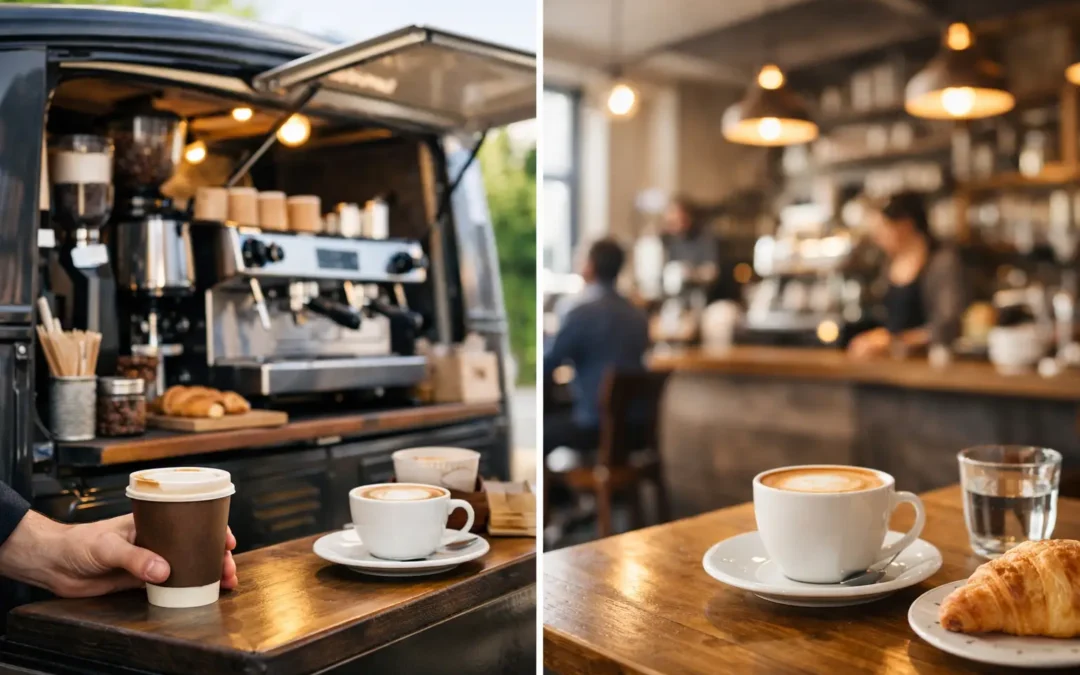
The question of coffee van vs cafe usually comes up when the stakes are surprisingly high. You are not just choosing where the coffee comes from. You are deciding how people gather, how smoothly an event runs, how an office starts the day, and whether convenience will come at the cost of quality.
That is why the right answer is rarely a flat yes or no. A great cafe offers atmosphere, familiarity and a place people choose to visit. A great coffee van brings that same freshly brewed, barista-made experience to you, with far less friction. The better fit depends on what you need the coffee to do.
Coffee van vs cafe for convenience
If convenience is the main factor, the advantage usually sits with the coffee van. A cafe asks people to travel, queue, order, wait and return. That works well when the outing is part of the appeal, like a weekend catch-up or a casual client meeting in a lively neighbourhood spot.
A coffee van changes the shape of the experience. Instead of moving your team, guests or attendees towards the coffee, the coffee comes to them. For workplaces, activations and private functions, that matters more than people often expect. Time stays on site. Energy stays in the room. People can grab a flat white between sessions, chats or tasks without leaving the flow of the day.
For office managers and event organisers, this is often the deciding factor. You are not coordinating transport, managing staggered coffee runs or watching staff disappear for 25 minutes at a time. You are creating an easy, polished service moment exactly where it is needed.
Where a cafe still wins
Cafes have strengths that a mobile setup does not always try to replace. The best ones offer a full environment – seating, ambience, food cabinets, regulars, music, and that familiar sense of place. Sometimes people want the ritual of walking in, hearing the grinder, spotting a favourite table and staying for a second cup.
That matters for social occasions built around lingering. If the goal is to meet, sit down, eat and settle in for an hour, a cafe may be the stronger option. It is designed for dwell time. The room itself is part of the product.
A cafe can also offer a broader permanent menu. If your group wants an extensive brunch spread, cabinet treats, retail shelves and indoor shelter all in one fixed location, that format has clear advantages.
So the cafe is not losing the comparison. It is simply built for a different kind of coffee moment.
Coffee van vs cafe on quality
Some people still assume mobile means lower quality. That might have been true years ago with basic setups and average beans, but it is not a rule anymore. A well-run specialty coffee van can produce café-quality drinks with beautifully textured milk, balanced espresso and the kind of consistency regular coffee drinkers notice straight away.
The real quality question is not whether the business has wheels. It is whether the operator cares about beans, equipment, water, workflow and training. Fresh roasting, careful dial-in and experienced baristas matter far more than whether the service point is inside bricks and mortar.
This is where a specialty-led mobile service can be a genuine standout. If the coffee is roasted with intention and served by people who understand extraction, milk texture and customer pace, every cup can still feel considered. You still get the crema, the aroma, the warmth in hand, the first sip that cuts through a cold Adelaide morning or lifts an afternoon event.
A cafe can absolutely deliver that. So can a coffee van. The difference comes down to standards, not format.
Cost looks different depending on the job
When people compare coffee van vs cafe, cost can be misleading if you only look at the cup price. A cafe might seem simpler because the venue already exists and guests buy individually. But that does not always mean it is the cheaper or smarter option overall.
For a business, the hidden cost of sending staff off site for coffee adds up quickly. Lost time, broken momentum and repeated trips can cost more than a well-organised on-site service. For events, a mobile coffee van can be easier to budget because the coffee experience is planned in advance rather than left to chance.
There is also a value difference. A booked coffee van is not just serving drinks. It is creating hospitality on arrival, giving people a reason to gather, and adding a premium touch without forcing them off site. At conferences, community days, brand activations and weddings, that changes the feel of the event.
A cafe, on the other hand, is cost-effective when individuals are paying their own way and the setting already suits the occasion. If no one needs service brought to them, the overhead of booking mobile catering may not be necessary.
The experience people actually remember
Coffee is practical, but it is never only practical. It shapes mood. It creates pauses. It gives guests something to hold, comment on and enjoy together. That is why experience matters in this comparison.
A cafe offers a destination experience. People arrive with expectation. The setting frames the visit. That can feel relaxed, intimate or vibrant depending on the venue.
A coffee van offers a hosted experience. It creates a focal point right where people are. The aroma of freshly brewed coffee drifting across an event site or workplace floor does something immediate. It signals care. It makes the space feel active, welcoming and looked after.
For branded events and corporate gatherings, that visibility matters too. A mobile setup feels lively and present. People see drinks being made, hear the steam wand, and connect quality with the event itself. It is not an afterthought tucked around the corner.
When a coffee van makes more sense
There are some situations where a coffee van is simply the more natural fit. Workplaces are a big one, especially when teams want better coffee without installing machines, stocking beans, cleaning equipment or relying on pods that never quite hit the mark.
Events are another obvious match. Outdoor functions, open days, sporting clubs, school communities, product launches and private celebrations all benefit from coffee that arrives ready to serve. You do not need guests leaving the venue to find a decent latte. You want the richest flavours and the service itself right there, on cue.
It also suits occasions where timing matters. Morning conferences, early site starts, media calls and customer appreciation days all run better when coffee is part of the plan rather than a scramble.
When a cafe is the better call
A cafe usually wins when place is part of the purpose. If you are planning a quiet conversation, a leisurely brunch or a low-key catch-up in a setting built for sitting down, the fixed venue offers something a van is not trying to imitate.
It can also be the better option when spontaneity is the point. If people are heading out for a wander and deciding on coffee as they go, a cafe suits that casual rhythm. There is no booking, no event structure, no service brief. Just the pleasure of dropping in.
For some businesses, a nearby local cafe may also work perfectly for informal meetings. If access is easy and the atmosphere fits, there is no need to overcomplicate it.
How to choose without overthinking it
The simplest way to decide is to ask one question first: do you want people to go to the coffee, or do you want the coffee to come to the people?
If the venue, seating and social setting matter most, choose the cafe. If ease, impact and on-site service matter most, choose the coffee van.
Then look at the finer details. How many people need serving? Are they paying individually or are you hosting? Do you want a quick, efficient coffee stop or an experience woven into the event? Is your priority atmosphere, or is it flexibility without losing quality?
That is where the comparison becomes useful instead of abstract. It stops being a debate about which format is better in general, and starts becoming a decision about what fits the moment best.
For many Adelaide businesses and event organisers, the answer is increasingly mobile. Freshly roasted beans, skilled baristas and a well-run van can deliver the café-quality experience people want, without the delay and logistics they do not. That is a strong combination, and it is exactly why services like Lygon Coffee resonate with teams and hosts who want every sip to feel easy, polished and genuinely memorable.
The best coffee setup is the one that makes the day run better and leaves people talking about the cup in their hands for all the right reasons.