

Most new owners like you weigh mobility, startup costs, customer volume, and lifestyle when choosing between a coffee van and a café-this guide helps you decide which model suits your business goals.
Key Takeaways:
- Startup costs and ongoing overhead determine fit: coffee vans need lower initial investment and smaller staff but offer limited service capacity, while cafés require higher rent and build-out costs yet support larger menus and steadier daily revenue.
- Location flexibility and customer reach differ: vans can follow events, offices, and peak crowds to test markets quickly, whereas cafés depend on fixed foot traffic and build repeat local customers through consistent presence.
- Owner lifestyle and growth path influence choice: vans suit owners wanting mobility, shorter hours, and easier concept testing; cafés suit those seeking a fuller in‑store experience, expanded offerings, and clearer paths to scaling or franchising.
Evaluating Your Initial Capital and Startup Costs
You should tally liquid capital, projected first-year cash flow and a minimum runway of three to six months; cafes typically demand higher lease and fit-out cash up front while vans shift costs into vehicle purchase, conversion and licenses, so include insurance and initial stock in your total.
Calculate conservative monthly burn and model best- and worst-case sales so you know how long your funds last before break-even; include a contingency for repairs, permit delays and seasonal dips to avoid surprise shortfalls.
Comparing Lease Deposits with Vehicle Procurement
Compare deposit scales: urban cafe leases often require several months’ rent plus guarantor agreements, whereas vans need a down payment and conversion costs; decide whether you can service debt or prefer lower recurring obligations.
Lease Deposits vs Vehicle Procurement
| Lease Deposits | Vehicle Procurement |
|---|---|
| High upfront rent and security deposits | Down payment plus conversion/build-out |
| Monthly rent predictable but long-term commitment | Financing varies; asset can be resold |
| Often requires guarantor or business history | Maintenance and insurance shift to you |
| Fit-out included in lease negotiations sometimes | Custom fit-outs may raise initial cost |
Budgeting for Specialized Equipment and Fit-outs
Budget for core items like espresso machines, grinders, filtration and point-of-sale; you should price commercial-grade options and compact alternatives for vans, plus plumbing, electrical and signage to meet health codes.
Allocate separate line items for installation, ventilation, permits, staff training and spare parts so you don’t erode operating cash when unexpected maintenance arises.
Determining the Impact of Location and Mobility
Location and mobility determine customer access and operating costs, so you must weigh steady foot traffic and rentable space against the flexibility to chase events and peak periods.
Analyzing Foot Traffic and Stationary Demographics
You should map hourly pedestrian flows, nearby businesses, and commuter patterns to forecast demand for a café or a van and to tailor hours, menu size, and staffing.
Capitalizing on Events and Changing High-Traffic Zones
Scout event calendars, construction alerts, and seasonal hotspots so you can place a van for temporary surges or position a café to benefit from recurring local gatherings.
Coordinate with event organizers, secure temporary permits early, and prepare portable menus and payment options so you can turn short-term spikes into repeat customers.
Managing Licensing and Regulatory Compliance
Navigating Health Permits for Fixed vs. Mobile Units
You should map health requirements early: a fixed café often needs full kitchen build standards and grease traps, while a coffee van must install handwash stations, fresh/grey water tanks and secure waste storage. Plan for inspections and approvals; see Coffee truck business- ideas and insight?
Understanding Local Council Zoning and Trading Laws
Your council will classify where you can trade, set permitted hours, require public liability insurance and specify equipment setbacks; check zoning maps and trading bylaws before committing to a site.
Check festival, market and private-property approvals separately, and ask for a pre-application meeting so you can avoid costly relocations or fines.
Designing an Efficient Operational Workflow
You should map core tasks to reduce steps during service, grouping prep, brewing, and handoff so your team moves with purpose and speed.
Set clear role playbooks and time-tested station layouts so you can scale service without adding chaos during morning surges or event days.
Optimizing Limited Space for Maximum Output
Compact footprints force smart choices: you pick multiuse equipment, vertical storage, and mobile carts to expand capacity without permanent buildout.
Position cold and hot flows to avoid cross-traffic, and label zones clearly so your staff can complete orders faster and you reduce mistakes under pressure.
Tailoring Your Menu to the Business Environment
Analyze local foot traffic and service rhythm so you choose items that fit your prep bandwidth and customer expectations, balancing speed with standout options.
Prioritize items with short assembly times and predictable yields so you keep consistency during peaks while controlling waste and labor strain.
Offer a rotating highlight that lets you test new concepts without bloating the standard menu, giving you quick feedback on what drives repeat business and margin.
Building a Sustainable Brand Identity
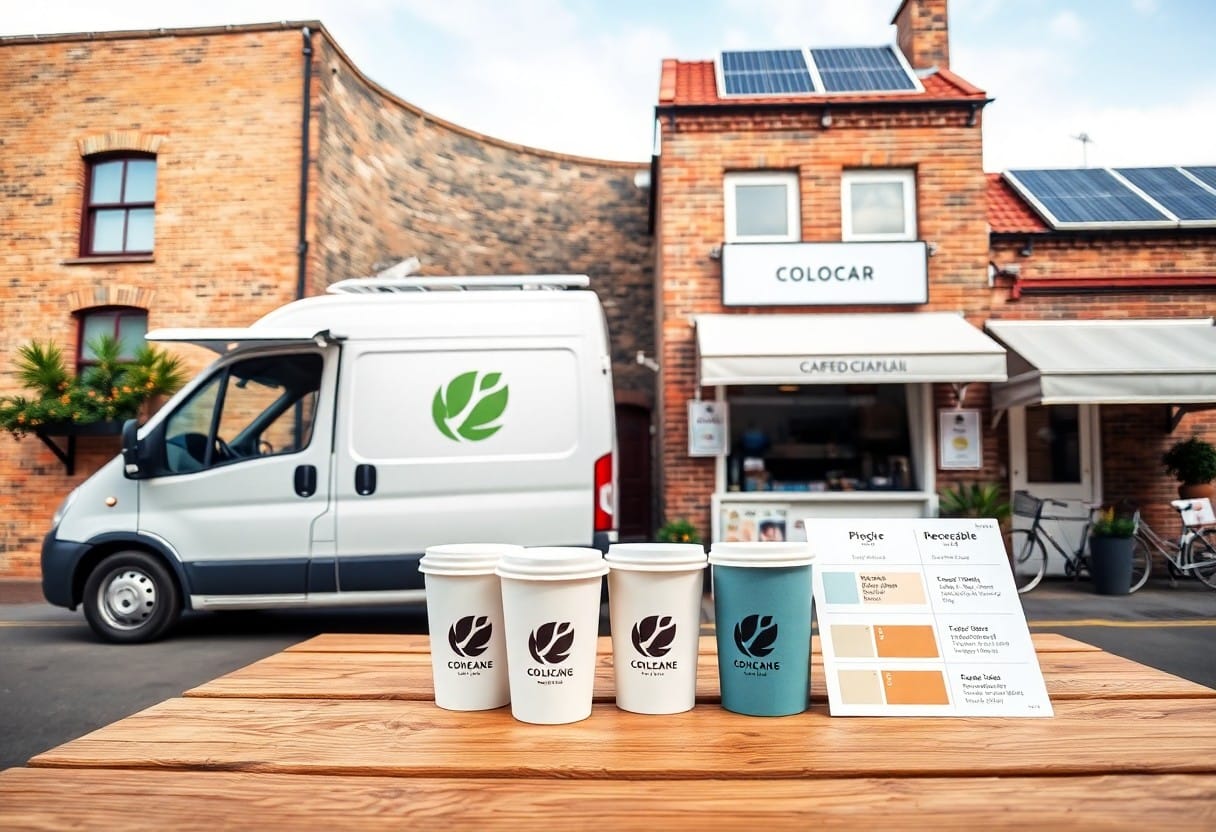
Branding should reflect your values and supplier choices so customers see consistency; you can standardize recyclable packaging, seasonal sourcing, and transparent messaging to make sustainability tangible across van or café.
Sourcing choices shape trust, so you should document origin stories, train staff to speak about those sources, and keep quality visible in every cup to build a reputation that lasts.
Creating a Destination Experience in a Café
Atmosphere sets expectations, so you should design seating, lighting, and scent to encourage lingering and repeat visits while aligning decor with your brand story.
Menu curation reinforces identity, so you should highlight signature drinks, rotate local collaborations, and train staff to recommend pairings that tie taste to your values.
Enhancing Visibility and Recognition for a Coffee Van
Visibility comes from bold vehicle graphics and a consistent color scheme so passersby instantly recognize your van; you should also publish a regular schedule to build routine foot traffic.
Social updates amplify reach, so you should post clear location notifications, short prep videos, and customer shout-outs that turn casual sightings into followers.
Signage and lighting complete the picture, so you should use illuminated logos, readable menus, and staff uniforms to speed ordering and make your brand memorable in busy settings.
Assessing Long-Term Scalability and Profit Factors
You should weigh fixed versus variable costs: a café demands rent, utilities and higher staff levels, while a van keeps lower overhead but limits hours and menu.
- Initial capital and financing options
- Recurring costs: rent, fuel, permits, insurance
- Staffing flexibility and training needs
- Peak versus off-peak revenue potential
Consider resale value, franchising potential and how quickly each model can add units; your choice should reflect which structure matches your growth timeline and risk tolerance.
Projecting Revenue Streams and Overhead Costs
Estimate daily sales, average ticket and add-on income from food, merchandise, catering or events, then map those to monthly overhead like rent, fuel, permits and payroll to build a cash-flow model.
This model reveals break-even days and helps you test scenarios such as seasonal dips or menu expansion against realistic margins.
Planning for Expansion and Multi-Unit Growth
Plan systems that are easy to replicate: supplier agreements, training manuals and POS configurations that work for both mobile and fixed sites.
Think about licensing, territory protections and the cost curve of each added unit; using a van to pilot a neighborhood can reduce the risk of a bad lease.
Any expansion should include conservative financial buffers, documented SOPs for quality control and a tech stack for inventory and sales reporting to protect margins as you grow.
Coffee Van Or Café? How To Decide Where To Brew Your Business Dreams
The choice between a coffee van and a café depends on your budget, target customers, and preferred work-life balance; you should weigh mobility, startup costs, staffing needs, and local demand to decide which setup aligns with your goals.
You can run short tests, compare permits and operating hours, and project cash flow to reduce risk before committing.
FAQ
Q: What are the typical startup costs for a coffee van versus a café?
A: A coffee van typically requires $15,000-$80,000 to start depending on whether you convert a used vehicle or buy new, plus $5,000-$20,000 for a quality espresso machine and grinder, $500-$2,000 for permits and inspections, and $500-$2,000 for initial stock and POS. A café often requires $50,000-$300,000 including lease deposit, $20,000-$150,000 fit-out, $10,000-$50,000 equipment and refrigeration, and several months of operating capital to cover wages and rent before breakeven. Cashflow cushion for a van can be smaller because overhead is lower; cashflow for a café must cover higher fixed costs such as rent and utilities.
Q: How do lifestyle and daily operations differ between running a van and running a café?
A: A coffee van offers flexible hours, event-focused shifts, and the ability to relocate to chase high-traffic opportunities, which suits owners who want mobility and variety in daily routines. A café requires fixed opening hours, staff scheduling, inventory management for larger stock, and more time on-site for customer service and upkeep, which suits owners who want a stable location and community presence. Weather, parking rules, and event schedules heavily affect vans, while rent, neighborhood footfall, and building maintenance impact cafés.
Q: How should I assess location and foot traffic when choosing between a van and a café?
A: For a van, map high-traffic spots like office parks, commuter hubs, markets, festivals, and construction sites, and test those locations with short runs to measure conversion rates and peak hours. For a café, analyze pedestrian counts, competitor mix, average local spend, and rent per square foot; calculate required daily covers based on average order value to reach break-even rent. Customer flow consistency tends to be higher for cafés in strong locations, while vans can concentrate profit on peak events but may face variable daily volume.
Q: What permits, health codes, and insurance do vans and cafés need?
A: A coffee van commonly needs vehicle registration for commercial use, mobile food vending permits, local parking or street vending permits, a food handler certification, and liability insurance; some jurisdictions require a commissary or commercial kitchen for food prep. A café needs a business license, food service permit, health inspections, building and occupancy approvals, zoning compliance, and general liability and property insurance. Permit timelines and costs vary widely by city, so confirm requirements with local health and planning departments before committing.
Q: How do equipment needs and menu choices differ between a van and a café?
A: Vans require compact, energy-efficient equipment: a compact or low-volume espresso machine, a single grinder, small refrigeration, a water system and heater, and secure storage for cups and supplies; menus tend to focus on high-turnover items like espresso drinks, batch-brew, cold brew, and handheld pastries. Cafés can support larger commercial espresso machines, multiple grinders, coffee bar equipment for pour-over or siphon, full-size refrigeration, and a kitchen for baked goods or light food, allowing a broader menu and higher-margin food items. Menu complexity increases staffing and training needs for cafés.
Q: Which option tends to be more profitable and how do revenue models compare?
A: Profitability depends on location, hours, and cost control. A van often has lower fixed costs and can achieve quicker payback if it secures regular event contracts or busy daily spots; example daily gross for a busy van might be $400-$1,200 with average order value $4-$7. A café typically generates higher gross revenue per day-$800-$3,500 depending on size and location-with average order values of $6-$12, but higher rent and wages reduce net profit. Gross margins on coffee are high for both models, but cafés must cover larger fixed expenses, making consistent footfall necessary for sustainable profits.
Q: What are realistic scaling and exit strategies for vans versus cafés?
A: Scaling a van operation usually involves duplicating the mobile model by adding more vehicles or contracting operators, which keeps capital requirements lower per unit and allows rapid geographic testing. Scaling a café often means opening additional locations, franchising, or developing wholesale channels, which requires larger capital, standardized operations, and stronger brand systems. Selling a café can be easier when the location has steady revenue and documented processes; selling a multi-van operation can attract buyers interested in mobile service contracts and recurring event relationships.