
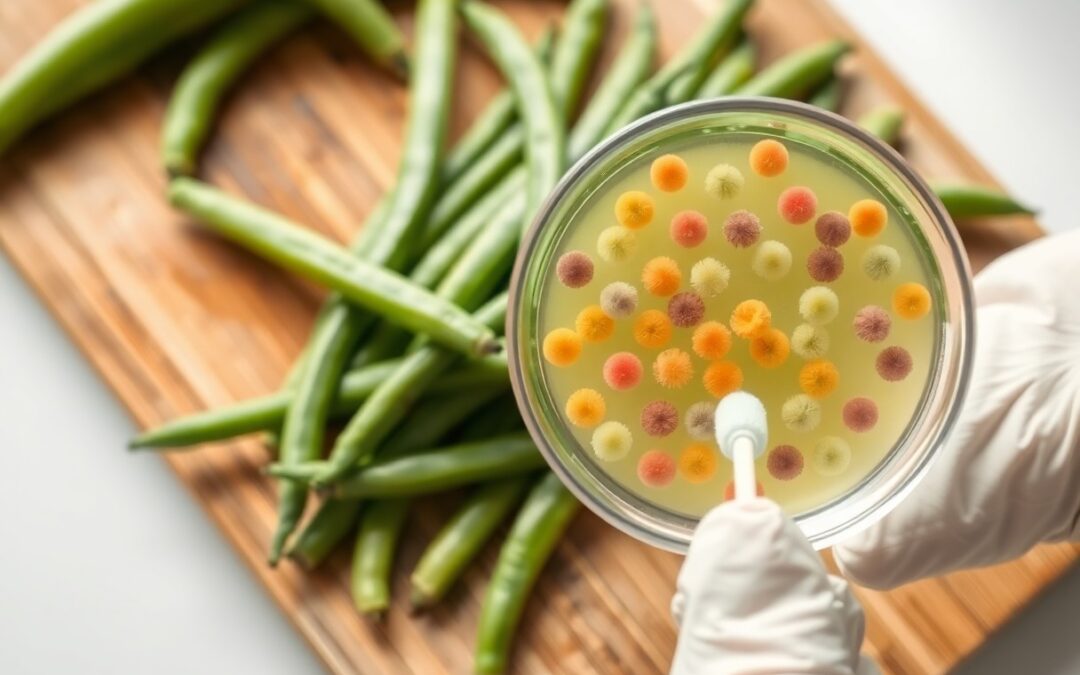
Microbial communities on beans influence spoilage, shelf life and flavor; you can identify beneficial bacteria that suppress pathogens, reduce moisture-driven decay, and inform storage strategies to maintain bean freshness.
Key Takeaways:
- Microbial communities on bean surfaces and inside pods shape spoilage dynamics by producing enzymes and metabolites that either accelerate or slow tissue breakdown.
- Beneficial bacteria and yeasts can suppress pathogens through competition, antimicrobial compounds, or acidification, extending bean shelf life under appropriate conditions.
- Storage factors such as humidity, temperature, and oxygen availability alter microbial composition, with low humidity and cool temperatures generally reducing spoilage-associated microbes.
Characterizing the Bean Microbiome
You can profile bean surface and internal microbiomes using amplicon sequencing and metagenomics to link taxa to spoilage patterns; consult Dynamics of microbial communities of fresh broad bean … for temporal insights on pod communities.
Studies pair repeated sampling with storage and environmental metadata so you can relate community shifts to handling, humidity, and temperature and refine preservation tactics.
Diversity of Epiphytic and Endophytic Populations
Epiphytic communities you observe on pod surfaces vary with field conditions and postharvest handling, influencing initial contamination loads and spoilage trajectories.
Endophytic assemblages colonize internal tissues and can modulate host physiology and resistance, so you should assess both compartments to predict longevity.
Core Taxa Associated with Legume Longevity
Core taxa are species consistently present across samples and time, and their persistence often correlates with slower decay when strains produce antagonistic compounds you can harness.
Key genera frequently detected include Pseudomonas and Bacillus among bacteria and certain yeasts; you should evaluate strain-level functions since effects on freshness are context dependent.
Additional work you pursue at strain resolution and with co‑culture experiments will reveal which core members suppress pathogens, guiding targeted biological preservatives and storage choices.
Mechanisms of Microbial Antagonism
Microbial interactions on bean surfaces determine which populations persist, and you can use this knowledge to encourage strains that suppress spoilage through resource capture and occupation of niches.
Antagonism combines nutrient competition, pH shifts, and enzyme secretion to limit degraders, giving you practical strategies for selecting cultures that maintain bean texture and flavor during storage.
Competitive Exclusion of Spoilage Organisms
Competition for sugars, amino acids, and oxygen allows you to tilt the balance toward harmless or beneficial microbes that prevent establishment of spoilage species on pods and harvested beans.
Surface colonization by rapid growers forms physical and biochemical barriers so you can reduce pathogen attachment and hinder biofilm development that accelerates decay.
Secretion of Antimicrobial Peptides and Bacteriocins
Secretion of bacteriocins and antimicrobial peptides offers you targeted inhibition of competitors, which can be applied via starter cultures to suppress decay agents without broad-spectrum disruptions.
Targeted peptide activity often disrupts membranes or vital pathways in spoilage bacteria while sparing helpful commensals, enabling you to shape a protective microbiome on beans.
Molecular profiling of these compounds helps you choose strains that produce stable, heat- and pH-tolerant bacteriocins so you can retain antimicrobial efficacy through handling and storage to extend bean shelf life.
Synergistic Interactions and Community Stability
Microbial networks stabilize bean surfaces by distributing metabolic tasks, so you benefit from reduced spoilage as antagonists suppress decay agents and mutualists maintain tissue homeostasis.
Community balance shifts when environmental stress favors protective strains, and you can see longer shelf life where interactions minimize tissue breakdown through shared enzymes and nutrient partitioning.
Quorum Sensing and its Role in Tissue Integrity
Quorum signals coordinate protective gene expression among bacteria on beans, enabling you to maintain cuticle integrity and delay softening by synchronizing antimicrobial production.
Signal disruption by competitors alters this coordination, so you notice increased vulnerability when beneficial signaling networks are interrupted during storage or handling.
Biofilm Formation as a Physical Barrier to Decay
Biofilms create extracellular matrices that shield bean tissue and restrict pathogen access, helping you preserve firmness by limiting enzymatic invasion and water loss.
Matrix composition varies with community members, meaning you observe stronger barriers when polysaccharide-rich films form from cooperative microbes.
Surface-associated biofilms also modulate microenvironments, so you find lowered oxygen and stabilized humidity that slow decay processes and extend freshness under typical storage conditions.
Environmental Modulators of Microbial Dynamics
Monitor local microclimates around your stored beans, since small temperature and humidity gradients shift which species dominate and how quickly spoilage progresses.
Balance ventilation and stacking to slow unwanted microbial growth while preserving bean texture, and you will extend sensory quality without heavy interventions.
Environmental factors vs microbial effects
| Factor | Effect on microflora |
|---|---|
| Temperature | Selects for psychrotrophs or mesophiles; influences growth rate and enzyme activity |
| Relative Humidity | Higher RH favors fungi and mycotoxin risk; lower RH reduces microbial activity but may dry beans |
| Air composition | High CO2/low O2 suppresses aerobes and alters community composition |
Impact of Temperature and Relative Humidity
Temperature swings around storage force you to adapt conditions, as warmer pockets accelerate microbial metabolism and enzymatic spoilage.
Humidity above about 70% pushes you toward fungal dominance and potential mycotoxin formation, while drier air slows growth but risks quality loss.
Influence of Modified Atmosphere Packaging on Microflora
Packaging with elevated CO2 suppresses aerobic spoilage organisms and lets you prolong freshness by slowing respiration and microbial proliferation.
Reduced oxygen atmospheres select for facultative anaerobes, so you must monitor for anaerobic spoilage and maintain barrier integrity.
You can pair MAP with moisture control and rapid cooling to minimize fungal proliferation and preserve sensory attributes during storage.
Biochemical Markers of Freshness
Monitor soluble sugars, organic acids, pigment integrity, and key enzyme activities as direct indicators of bean freshness, since microbial metabolism can modify these signals and alter perceived quality; you should interpret biochemical readouts alongside microbiological data.
Track dynamic ratios such as sugar-to-acid and redox-related markers to separate physiological senescence from microbially driven decay, and you can combine rapid assays with sensor outputs to refine shelf-life estimates.
Microbial Volatile Organic Compounds (mVOCs)
Analyze mVOCs including short-chain alcohols, ketones, and sulfur compounds to detect microbial states that correlate with spoilage or preservation, and you can use GC-MS or electronic noses to capture these volatile fingerprints.
Interpreting volatile profiles helps you distinguish fermentation-dominated deterioration from enzymatic degradation by native flora, so integrate mVOC patterns with biochemical assays to improve diagnostic precision.
Metabolic Shifts During Post-Harvest Storage
Expect shifts in respiration, increased fermentation, sugar depletion, and accumulation of organic acids or ethanol during storage that are amplified by microbial colonization, and you should monitor these kinetics to guide storage conditions.
Assess time-course measurements of sucrose decline, fructose rise, free amino acid accumulation, lipid peroxidation, and enzyme activities like polyphenol oxidase and peroxidase to model freshness trajectories and predict sensory loss.
Biotechnological Interventions for Shelf-Life Extension
You can deploy enzyme inhibitors, bacteriocins, and tailored microbial inoculants to suppress spoilage agents on beans, preserving texture and flavor with reduced chemical inputs. Postharvest coatings that host beneficial strains give you active protection while lowering reliance on cold chain intensity.
Trials under commercial conditions help you verify strain compatibility, sensory effects, and regulatory compliance, while rapid sequencing lets you monitor microbial dynamics. Choose practices that provide clear safety data so you can scale interventions responsibly.
Application of Protective Cultures and Probiotics
Protective cultures applied as washes or coatings can outcompete spoilage microbes and secrete antimicrobials, giving you a living barrier that extends freshness. Assess strain stability and sensory impact before routine use to ensure consumer acceptance.
When you pair these cultures with mild physical treatments or controlled atmospheres, synergistic shelf-life gains often appear; implement rapid diagnostics to track shifts and adjust strain combinations proactively.
Targeted Microbiome Engineering in Sustainable Agriculture
Engineered consortia can be designed to suppress decay pathways and boost antioxidant levels in beans, offering you targeted postharvest control. Apply gene-based methods only with solid biosafety data and transparent labeling to maintain public trust.
Field manipulation of soil and seed microbiomes gives you upstream benefits-healthier plants, lower pathogen loads at harvest, and beans that resist spoilage longer in storage; integrate agronomic practices with microbiome monitoring to sustain strain persistence and performance.
Conclusion
Conclusively you observe that microbial interactions shape bean freshness by competing with pathogens, producing antimicrobials, and influencing moisture and aroma. You can preserve quality by controlling storage temperature and humidity and by encouraging beneficial microbiota through targeted practices, which together reduce spoilage and extend shelf life without compromising flavor.
FAQ
Q: What are microbial interactions and how do they affect bean freshness?
A: Microbial interactions describe how bacteria, yeasts, and molds on bean surfaces and interiors compete, cooperate, or inhibit one another. Competitive exclusion by faster-growing bacteria can reduce populations of spoilage organisms, while antagonistic microbes produce acids, bacteriocins, or antifungal compounds that slow decay. Cooperative interactions among spoilage organisms can accelerate tissue breakdown and off-odors, shortening shelf life.
Q: Which microbes most commonly influence spoilage or preservation of fresh beans?
A: Common spoilage microbes include Pseudomonas spp., Enterobacteriaceae, yeasts (Candida, Pichia), and filamentous fungi (Penicillium, Aspergillus). Protective or beneficial groups include lactic acid bacteria and certain Bacillus and yeast strains that produce organic acids, antimicrobial peptides, or volatile compounds suppressing pathogens and molds.
Q: By what mechanisms do antagonistic microbes help maintain bean freshness?
A: Antagonistic microbes reduce spoilage by consuming available nutrients, lowering pH through acid production, secreting antimicrobial compounds (bacteriocins, organic acids, antifungal metabolites), and forming biofilms that occupy niches and prevent colonization by pathogens. Some strains also induce plant tissue changes that increase resistance to enzymatic breakdown.
Q: Can deliberate microbial treatments or fermentation be used to extend bean shelf life?
A: Controlled fermentation and application of protective cultures can extend shelf life for some beans. Fermentation is widely used for coffee and cocoa to develop flavor and reduce certain spoilage organisms. For fresh vegetables and legumes, coating or washing with selected antagonistic cultures or fermentation-derived metabolites can suppress spoilage, but protocols require validation for safety, flavor impact, and regulatory approval.
Q: How do storage conditions interact with microbial communities to influence freshness?
A: Temperature, relative humidity, gas composition, and water activity strongly shape which microbes dominate. Low temperature and reduced humidity slow microbial growth and enzyme activity. Modified atmosphere packaging that lowers oxygen or increases CO2 can suppress aerobes like Pseudomonas but may favor facultative anaerobes if conditions are not controlled carefully.
Q: What practical measures can producers and handlers take to manage microbial interactions and keep beans fresh?
A: Good practices include rapid cooling after harvest, thorough cleaning and sorting to remove damaged beans, controlling humidity, using proper drying for storage-grade beans, and employing MAP or refrigeration. Use of validated biocontrol strains or natural antimicrobials can be effective when tested for the specific bean type. Routine microbial monitoring (plate counts, targeted PCR) helps detect shifts toward spoilage communities early.
Q: Are there food-safety risks when manipulating microbial communities on beans?
A: Manipulation carries risks if pathogenic or toxigenic organisms are inadvertently promoted. Some fungi can produce mycotoxins under improper storage. Introduction of live cultures requires strain safety assessment, absence of transferable antibiotic resistance, and adherence to local food regulations. Consumer acceptance and clear labeling should be addressed when using microbial treatments.